


Excel For Mac Edit List Range
The FREQUENCY function is a built-in function in Excel that is categorized as a Statistical Function. It can be used as a worksheet function (WS) in Excel. As a worksheet function, the FREQUENCY function can be entered as part of a formula in a cell of a worksheet. This tutorial will guide you on how to make a checkbox in Excel and use the check box results in formulas to create an interactive checklist, to-do list, report or graph. Database is your table or range including the column headings (A5:F48 in this example). Apps for Excel for Mac. Merge two worksheets. Count & Sum colored cells.
Such features I have been able to go without and many people probably don’t use them often. When it comes to Microsoft’s Excel app, too many features are left out and the app is almost rendered useless for engineering work. I need to be able to manipulate line graphs, scatter plots, and data and this app doesn’t allow me to do so. If I have 2 columns of data, I need to plot one versus the other, and this app doesn’t allow me to do so. Then once I do that, I need to be able to see all the data that comes with the graph that is generated, like the r^2 value and setting tolerances for trend lines etc. Maybe it was a far fetched idea in the first place to think I could use an iPad for all my college engineering work, but its frustrating when I can do literally everything else on my iPad faster, easier, and more convenient than with a laptop, EXCEPT for Microsoft Excel. Literally the only drawback I have with my iPad.
Lightroom 6 crack mac. Adobe lightroom for mac cloud plan. This means your range does dynamically expand but the downside is you have to manually create a named range AS WELL AS the table!! Author's Reply April 11th, 2012 @Alex Brilliant! Honestly, I only really discovered Excel tables in the last 9 months or so. I tried referencing a table directly from data validation, and you’re right, it doesn’t work.
The formula is based on the that returns 'Yes' if the number of completed tasks is equal to the tasks total, 'No' otherwise: =IF(B14=B15, 'Yep!' , 'Nope:(') To embellish your checklist a bit further, you can create a couple of that will change the color of cell B18 depending on its value. Once that's completed, hide the column with linked cells, and your Excel checklist is done! If you like the checklist we've created for this example, you are welcome to download it now: More Excel checklist templates To quickly get a selection of checklist templates for Excel, click File > New, type 'checklist' in the search box, and press Enter. If none of Excel's checklist templates is well suited for your needs, you may find useful the following resources helpful: • (for Excel and Word) • • (with a number of variations and enhancement) How to create a To-Do list with conditional formatting Basically, you can add checkboxes and formulas for a to-do list exactly in the same way as we have just done for the.
Microsoft Excel for Mac works with the following file extensions: Note: You can click on any file extension link from the list below, to view its detailed information. The list of extensions used or otherwise associated with the application may not be complete, because many common file extensions on our website, such as jpg (pictures) or txt (text files), can be opened by a large number of applications, or are too general file format. However most, if not all directly associated file extensions should be listed with its appropriate program.
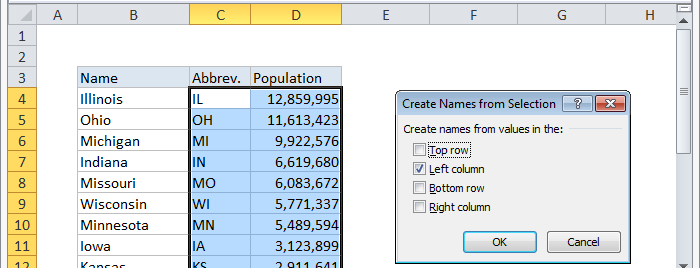
Excel List Range Names
One of the other useful features of names ranges is as a navigation tool. Once you have ranges defined, simply typing the name in the Name Box and hitting enter will take you directly to that named range. This is very useful if you want to quickly jump to a particular cell within a workbook with many worksheets or within a very large worksheet itself. To remove a Named Range choose Insert > Name >Define.
Free Excel For Mac
Granted, your IF statement is handly for making sure that you can’t pick a seleciton from B2 UNTIL you’ve made a seleciton from A2. But it doesn’t help with the above scenario, where you in fact DID make a selection from A2, then made a valid selection from B2, but then subseqently changed your selection in A2 making the data in B2 out of context.